How to Buy Original Art: A Collector’s Guide to Choosing Art You Love
Buying original art is different from buying almost anything else.
A painting is not simply an object that fills an empty wall. It can become part of your home, your daily life, your memories, and eventually your personal history. The right artwork can stay with you for decades — sometimes for generations.
But if you are buying original art for the first time, the process can feel intimidating. How do you know what to choose? Does the artist need to be famous? Should you think about investment value? What is the difference between an original artwork and a print? And how do you know if the price is fair?
After more than 20 years of creating art and seeing my work become part of private collections around the world, I have learned something very simple:
The best place to begin is with a work you genuinely want to live with.
Everything else comes after that.
1. Buy Art You Feel Something About
There are many reasons to collect art: beauty, inspiration, cultural significance, supporting an artist, building a collection, or potentially owning something that becomes more valuable over time.
But before thinking about any of those things, ask yourself one question:
Do I want to see this artwork every day?
Original art has an energy that is difficult to understand from a photograph alone. Sometimes you see a painting and immediately feel a connection. You may not even be able to explain why.
Pay attention to that feeling.
Trends change. Interiors change. Markets change. But a genuine emotional connection with a work can last for decades.
This philosophy is also at the center of my own practice: Do What You Love.
I believe the art we surround ourselves with should remind us of something meaningful — who we are, what we believe in, or how we want to live.
2. Understand What “Original Art” Means
An original artwork is a unique work created by the artist.
For example, an original painting exists as one physical artwork. Even if photographs or prints of that painting are later produced, there is still only one original.
A print is different.
Prints can be beautiful and collectible, particularly when they are signed and produced as limited editions, but they are reproductions or editions rather than the unique original work.
Neither is inherently better. They simply serve different purposes and often exist at very different price points.
If you are considering a work, check whether it is:
an original artwork;
a one-of-one piece;
a limited edition;
a signed print;
or an open-edition reproduction.
A professional artist or gallery should make this clear.
3. Learn About the Artist
When you buy an original artwork, you are also becoming part of an artist’s story.
Spend some time learning about the person behind the work.
Look at their previous artworks, exhibitions, projects, interviews and evolution over time. Read their artist statement. See whether there is a consistent idea or visual language connecting their work.
You don’t need to become an art historian.
You simply want to understand:
Why does this artist create what they create?
For me, Do What You Love began as more than a phrase. It became a philosophy that has followed my work through paintings, murals, objects, public projects and sculpture.
The individual works change, but the central question remains the same:
Are you living the life you actually love?
Knowing the story behind a work can completely change the experience of owning it.
4. Don’t Buy a Signature — Buy the Work
A famous name can add cultural and market significance to an artwork, but a recognizable signature alone doesn’t guarantee that you will enjoy living with it.
The opposite is also true.
Discovering an artist before they become widely known can be one of the most rewarding parts of collecting contemporary art.
Instead of asking only:
“Is this artist famous?”
also ask:
“Is this work important to me?”
A meaningful collection does not have to look like somebody else’s collection.
It should look like yours.
5. Think About Where the Artwork Will Live
Before purchasing a painting, consider the physical space.
Measure the wall.
Then measure it again.
One of the most common mistakes people make when buying art online is imagining a work much larger or smaller than it actually is.
Look carefully at the dimensions and, when possible, ask for photographs or a digital mockup showing the artwork in an interior.
Large original paintings can completely transform a room. Smaller works can create more intimate moments or become part of a larger collection wall.
There is no universal correct size.
The important thing is understanding the relationship between the artwork and the space around it.
And don’t be afraid of a large painting.
Sometimes people choose art that is too small because they are afraid the artwork will dominate the room. In reality, one strong original piece can often make a space feel much more intentional than several small decorative objects.
6. Ask About Materials and Condition
Before acquiring an original artwork, you should know what you are buying.
For a painting, basic information normally includes:
Artist Title Year Medium Dimensions Surface or material Signature Condition
For example:
Acrylic and mixed media on canvas, 48 × 60 inches, signed by the artist.
For older works, condition becomes particularly important. For contemporary works purchased directly from an artist, the process is generally much simpler, but the materials should still be documented.
7. Ask for a Certificate of Authenticity
When purchasing an original artwork directly from an artist or gallery, ask whether it comes with a Certificate of Authenticity (COA).
A certificate typically documents information such as the artist’s name, artwork title, year, dimensions, medium and signature.
Keep this document together with your records for the artwork.
It can become important for provenance, insurance, resale, inheritance or future authentication.
The paperwork may seem unimportant when you first fall in love with a painting, but twenty years later it may matter considerably.
8. Buying Art Directly From an Artist
One of the most interesting changes in the contemporary art world is that collectors can now discover and communicate directly with artists.
You no longer necessarily need to encounter an artist through a gallery first.
Instagram, artists’ websites, studio visits and online exhibitions have made that relationship much more direct.
Buying directly from an artist can also allow you to learn the story of a particular work, see additional available pieces, visit the studio, or discuss a commission.
If you are interested in a work but cannot find a price, don’t assume it isn’t available.
Simply ask.
“Is this work available?”
is a completely normal question.
So is:
“Could you send me a list of currently available works?”
You do not need to know special art-world language to talk to an artist.
9. Consider a Commission
Sometimes you love an artist’s work but the available pieces are not the right size, composition or direction for your space.
That is where a commissioned artwork can make sense.
A commission is an original work created specifically for a collector.
Depending on the artist, you may be able to discuss dimensions, general colors, subject, concept or the environment where the artwork will live.
However, commissioning an artist is different from hiring someone simply to reproduce an image.
The best commissions leave space for the artist to remain an artist.
You are choosing them because you trust their visual language.
A good commission becomes a collaboration between your story and theirs.
10. Should You Buy Art as an Investment?
This is one of the questions collectors ask most often.
Art can increase in value. Some artists’ markets develop dramatically over time.
But no responsible artist can promise what the future market value of a work will be.
That is why I personally believe financial appreciation should be considered a possibility rather than the only reason to buy.
If an artwork increases in value, wonderful.
But during all the years before that happens — or even if it never happens — you should still own something that gives you something every time you see it.
That is a return too.
11. Don’t Be Afraid to Start Small
You don’t need millions of dollars to become an art collector.
A collection begins with one artwork.
It might be a painting, drawing, photograph, sculpture or limited edition.
Over time, those individual decisions begin to tell a story about you: the artists you discovered, the periods of your life when you found them, the places you traveled, and the ideas that mattered to you.
That is what makes a personal art collection interesting.
It is not simply a group of expensive objects.
It is a visual autobiography.
12. Buy From People and Sources You Trust
Whether you purchase from an artist, gallery, art fair or online platform, make sure you understand who is selling the work.
For significant purchases, don’t hesitate to ask questions about authenticity, provenance, condition, shipping and documentation.
When buying directly from a living artist, communication is often especially straightforward because the provenance begins with the person who actually created the work.
13. Think Beyond Decoration
There is nothing wrong with choosing an artwork because it looks beautiful in your home.
But the best art can do much more than match a sofa.
It can challenge you.
It can make you laugh.
It can remind you of someone.
It can represent a particular period of your life.
It can become something your children grow up seeing every day.
And sometimes one sentence on a canvas can change the direction of someone’s life.
That possibility is one of the reasons I continue making art.
Choose Something You Would Miss
If you are deciding whether to buy an artwork, imagine the space without it.
Then imagine living with it for ten years.
Would you still want to look at it?
Would you miss it if someone else bought it tomorrow?
If the answer is yes, you probably already know more than you think.
Collecting art does not have to begin with expertise.
From the very first day I stepped onto the playa at Burning Man, I dreamed of bringing my own installation. I would walk through the desert, looking at these incredible works of art, imagining that one day my own sculpture would stand among them.
But every year, I told myself the same thing: next year.
I thought about applying for an art grant, about the budget, about everything I would need to prepare. I understood that behind every installation were money, transportation, people, and countless decisions you never see as a visitor. The dream stayed with me, along with the feeling that I needed to be better prepared before making it happen.
This year, things went differently.
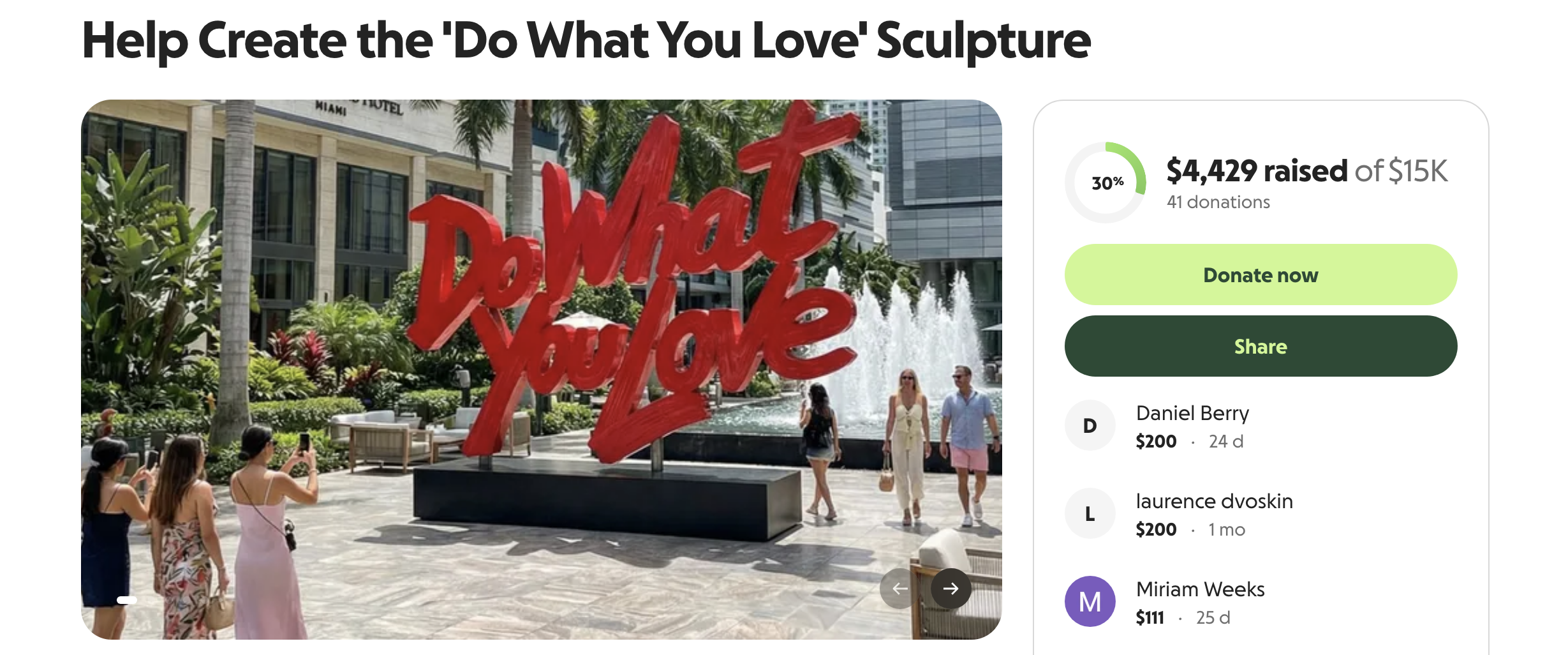
On July 26, my birthday, I launched a fundraiser to create my DO WHAT YOU LOVE sculpture. https://www.gofundme.com/f/help-create-the-do-what-you-love-sculpture
Honestly, I wasn’t initially planning to bring it to that year’s Burning Man. The event was only a month away. I just wanted to get started—to take the first step toward something I had dreamed about for years.
In about two weeks, we raised almost $4,500. People donated, encouraged me, and believed in the idea. Little by little, it started becoming real.
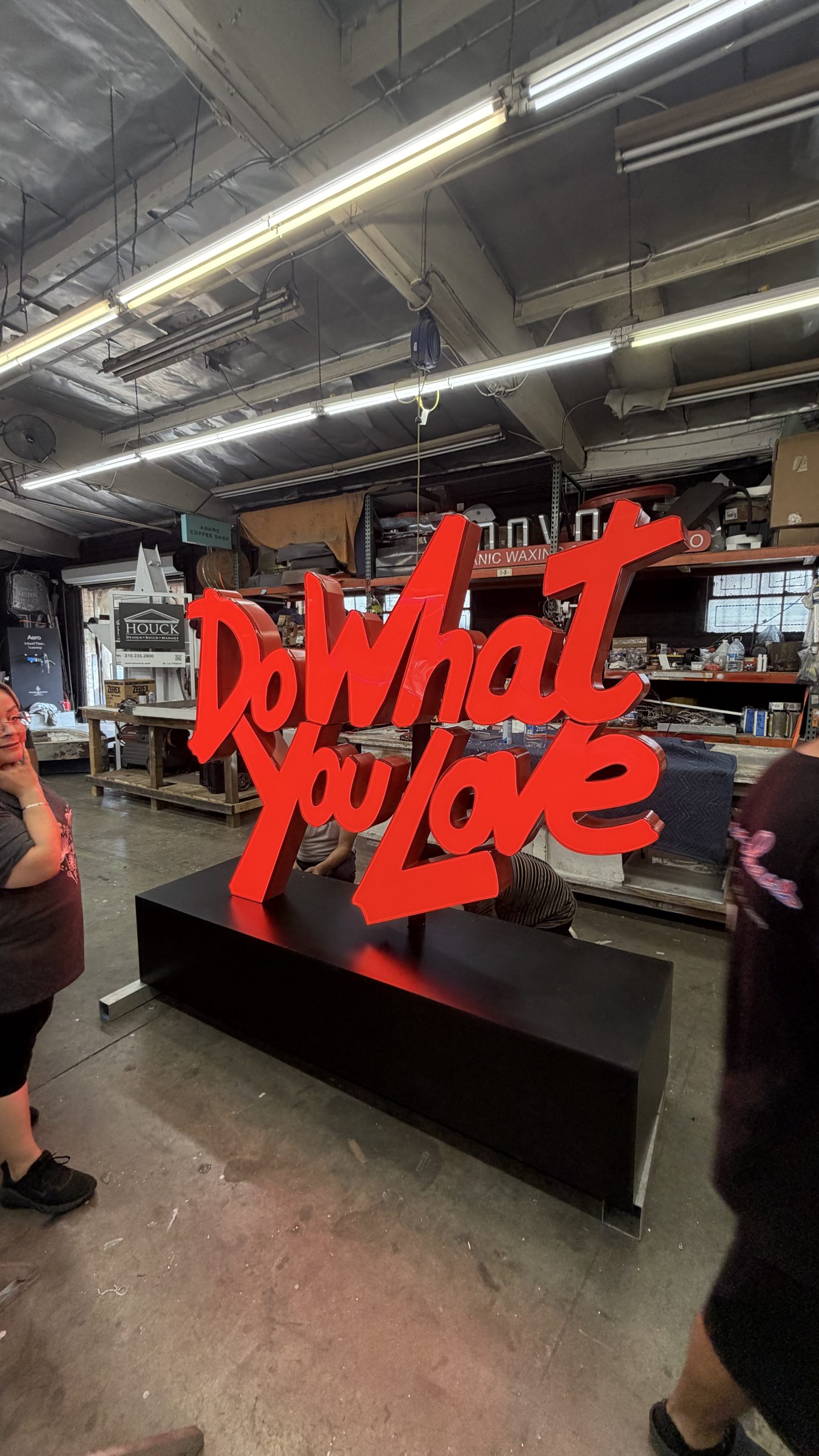
Around the same time, I met someone in Los Angeles who makes signs and commercial displays. He agreed to build the sculpture, worked with my budget, and said he could finish it in two to two and a half weeks.
Suddenly, there was a chance we could make it in time.
I sent him my drawings. We discussed the dimensions, the structure, and how everything should look. I tried to keep my expectations in check. There was very little time, and everything had to come together almost down to the day.
While the sculpture was being built, I started looking for a way to get it to the desert. It wouldn’t fit in a regular car. I posted in Burner groups, reached out to friends, and asked around for anyone who might have room to transport it.
My friends from Army of Love came through:
“Sergey, yes, we’ll take it. Bring it over.”
First, though, I had to get it to their loading location, about three hours outside Los Angeles. A friend lent me his van, and on one of the last nights before our departure, I drove the sculpture out so the crew could load it onto their truck.
I didn’t get home until five in the morning. We still had our own packing and trip to Burning Man ahead of us.
I thought the hardest part was behind me.
When we arrived on the playa on the evening of August 30, we learned that the truck carrying the sculpture had broken down on the way. We were there. The sculpture wasn’t.
All we could do was wait.
The truck finally arrived on Monday evening. The next morning, we assembled the sculpture and temporarily set it up at Army of Love’s camp. It wasn’t anchored to the ground yet. Strong winds picked up, and it fell over a couple of times. Thankfully, there was no major damage, but it was clear we still had work to do.
Friends helped move it to our camp. We then received permission to install the artwork on the playa and were given a great spot around 7:30, near Esplanade. The whole process was new to me. For the first time, I was there with my own sculpture, figuring out how to get it installed.
The next challenge was anchoring it.
I had brought anchors, but they turned out to be the wrong kind for the installation. Then, by chance, I met another artist, Andrey, who also had artwork on the playa. When I explained the problem, he said:
“I have spare anchors. You can use them.”
He gave me the anchors and pointed me toward the right tool. Together with people from our camp, we got to work. Even then, there was another surprise: one of the anchors broke during installation. We had to work through that on the spot and finish securing the sculpture.
And then, there it was.
My sculpture was standing on the playa.
I looked at it and could hardly believe it had happened. After years of saying “someday,” after the fundraiser, the overnight drive, the broken-down truck, and all the searching and problem-solving—it was finally there.
But we still needed light.
I wanted the sculpture to come alive at night, which meant finding a power source. I went from camp to camp, asked friends, and explored different options. For a while, nothing worked out.
Then Borya from Camp Plov Craft said:
“Of course, Sergey. Take it. No problem.”
He lent us his generator through Sunday. It was an enormous help. After that came the search for gas, trips to pick it up, and regular refueling. Keeping the sculpture lit became its own little daily routine.
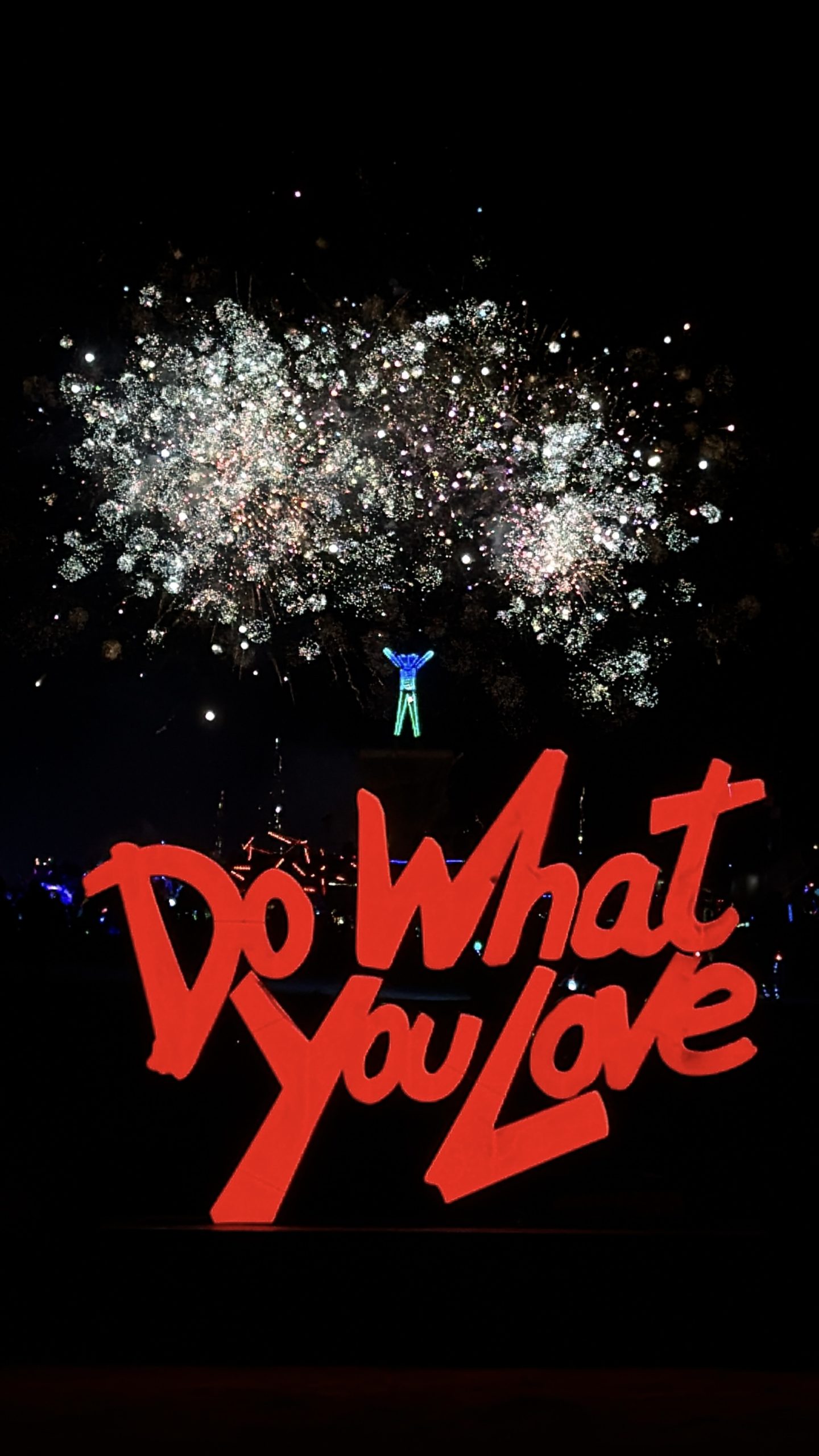
But the generator ran. The sculpture glowed. And I was happy.
Throughout that week, I kept hearing simple words: “Bring it over.” “I’ll help.” “I have one.” “Take it.” Every time, there was a person behind those words who made the next step possible.
This piece wouldn’t have made it to the playa without everyone who supported the fundraiser, the fabricator who took on such a tight deadline, the friend who lent me his van, Army of Love, the people in our camp, Andrey, and Borya from Plov Craft.
For me, this became one of the most meaningful experiences of my life as an artist. I had brought paintings to Burning Man before. This time, my message took on a physical, three-dimensional form and occupied its own space in the desert. You could walk up to it, move around it, and see it glowing in the distance at night.
I had imagined that moment for years. And when it finally arrived, what I felt most was gratitude.
To everyone who helped bring this dream to the playa—thank you. Every time I looked at the sculpture glowing in the desert, I knew how many people were behind that light.
Burning Man 2025 became one of the most meaningful experiences of my journey as an artist.
Every year, the playa brings something new — deeper connections, new inspiration, and unexpected moments that stay with you forever.
One of those moments happened during a simple morning yoga session.
I arrived early, sat down, and noticed someone next to me writing postcards — official Burning Man postcards, filled with vibrant imagery from the playa.
And then I saw something that stopped me.
One of the postcards featured me.
Walking with my “Do What You Love” painting in front of the Temple.
Seeing My Own Art Become Part of Burning Man
At first, it didn’t feel real.
I asked her where she got it.
She told me these were official postcards available at the Burning Man post office.
Right after yoga, I went there immediately.
I showed them the postcard and said, “That’s me. That’s my artwork.”
They smiled — and handed me a stack.
I walked away with around 20–30 postcards featuring my work — a surreal moment I’ll never forget.
The Photographer Behind the Image
Later, I tracked down the photographer and reached out to express my gratitude.
He’s an official Burning Man photographer who has been documenting the playa for over a decade — capturing its essence, art, and people.
Each year, Burning Man releases a limited series of official postcards — typically around 20–25 unique designs.
And one of those featured me and my artwork.
Out of thousands of moments captured on the playa, this one became part of the official visual story.
From Postcard to Mural
What made this experience even more powerful is what happened next.
I didn’t apply for a mural space that year.
I was late.
No submission. No plan.
But I still showed up at the central camp and asked if there was any wall available.
They gave me one.
Right in the central area.
There, I created a “LOVE” mural — a reflection of my philosophy and the message behind all my work.
Looking back, I can’t help but feel that everything was connected.
The Energy of “Do What You Love”
This moment wasn’t just about recognition.
It was about alignment.
When you consistently create from truth, when you follow your path without forcing outcomes — things begin to unfold naturally.
I didn’t plan to be on an official Burning Man postcard. I didn’t plan to get a mural wall.
I simply showed up and did what I love.
And sometimes, that’s exactly what opens the right doors.
Keywords: Burning Man 2025, Burning Man artist, Do What You Love art, Temple Burning Man, Burning Man photography, playa art, mural artist Los Angeles, contemporary artist USA
About the Artist
Sergey Gordienko is a Los Angeles-based contemporary artist known for his signature message “Do What You Love.” His work has been collected worldwide and exhibited at major art events including Art Basel.
CTA (SEO-friendly): Explore more artworks and projects: 👉 https://dowhatyoulove.art 📩 For collaborations, murals, and collectors inquiries — reach out directly.
Today, something I had feared for a while happened again. Four of my artworks were stolen. This isn’t the first time my art has been taken, but this incident pushed me to share my story. Over the years, I’ve experienced several thefts of my work, and while I’ve tried to move on, I’ve reached a point where I can’t and won’t stay silent anymore. Here, I’ll recount each episode as vividly as I remember.
—
### **Bitcoin Conference 2022**
The first painting that was stolen happened during the Bitcoin Conference in 2022. It was a chaotic day, filled with energy and movement. As I was walking back and forth from the event space to the parking lot, loading unsold pieces into my car, someone took my artwork. The piece, titled **”Decentralize,”** was a framed 20×28″ painting valued at $3,500. I didn’t notice it missing until I got home, and by then, it was too late. This was my first major loss, and it stung deeply.
—
### **Vegan Restaurant Incident, 2023**
The next piece disappeared under very suspicious circumstances. I had loaned one of my paintings to a vegan restaurant called **”Under the Mango Tree”** in South Beach, where it decorated the space for a while. One day, I visited the restaurant only to find the painting missing. When I called the owner, Patty, she claimed the piece had been accidentally destroyed by workers during a remodeling project. However, her story didn’t sit right with me. Initially, she said she had taken it home, then later claimed she thought I had gifted it to the restaurant since I hadn’t visited in a while. When I pressed for details and asked for the contacts of the workers involved, she refused to provide them. The whole ordeal felt suspicious and hurtful. That painting was a 24×24″ piece valued at $3,000. I’ve since stopped visiting what used to be one of my favorite vegan spots.
—
### **Gallery Dispute, 2019**
Back in 2019, when I operated my gallery in downtown Miami, I encountered another frustrating situation. A woman named Sara, who owned multiple clothing stores, purchased one of my paintings and expressed interest in collaborating on her jacket designs. She paid for one piece but took a second painting on the promise of paying for it later. Despite multiple calls and reminders, she never fulfilled her promise. When I asked her to return the unpaid painting, she initially agreed but never followed through. This particular painting was a 30×30″ piece valued at $4,500.
—
### **Mining Disrupt 2023**
Another theft occurred during the Mining Disrupt crypto conference in 2023. A large, unstretched canvas measuring 50×50″ was taken directly from the wall during the event. The piece was valued at $8,000. Despite reaching out to event organizers and attendees, I never recovered it.
—
### **Earthy Office Theft, 2024**
This latest incident has left me heartbroken. Back in June 2024, my friend Sam Singer rented an office for his startup, Earthy. As part of the branding and UI/UX design I was helping with, I displayed four of my artworks in the office. Over time, Sam traveled to Dubai to raise funds, and I stopped visiting the office. When I eventually decided to retrieve my art, I found the office completely empty. Sam’s colleagues and partners claimed they knew nothing about the missing artworks, and the landlord, Amir, denied taking anything.
These stolen paintings were large and highly valuable:
1. **48×72″ painting** – Valued at $15,000
2. **40×40″ painting** – Valued at $10,000
3. **36×60″ painting** – Valued at $9,000
4. **36×48″ painting** – Valued at $12,000
This incident, involving four pieces at once, is devastating. These weren’t just artworks; they were pieces of my soul, poured into each brushstroke.
—
### **If You See These Artworks**
If you’ve seen any of these paintings or know of their whereabouts, please reach out. My art is more than a livelihood—it’s my passion and identity. Losing these pieces has been heartbreaking, but I’m hopeful that by sharing my story, I can bring awareness and possibly recover what’s been lost. Thank you for your support.
In 2023, Do What You Love found its way into music.
It started after a trip to Tulum, Mexico, where I met Tanya Andros, a Ukrainian DJ and music creator. We connected through art, music, and a shared creative energy, and stayed in touch after I returned to Miami.
Not long after, Tanya reached out to me with a simple idea:
“Sergey, let’s make a track together.”
My answer was easy: “Of course. Let’s do it.”
I gathered a few of my musician friends in Miami, and we went into the studio. We recorded vocals with my friend Rose, experimented with different sounds, and captured everything as separate tracks. Then I sent all the recordings to Tanya in Tulum.
That’s where everything came together.
Tanya took the raw recordings, produced and mixed them, and turned our experiment into a finished Do What You Love track.
Suddenly, something that had existed for years in my paintings, murals, clothes, installations, and words had another form.
It became music.
After that, the track became part of my world. We played it at my parties, art events, and gatherings. Hearing people dance to the same message I had been painting for years felt completely different.
And this first collaboration gave me a much bigger idea.
I want to create an entire Do What You Love album.
Not one genre. Not one sound. Not one musician.
The idea is to collaborate with different musicians and producers and let each of them interpret Do What You Love in their own way — electronic, rock, hip-hop, experimental, acoustic, and whatever else naturally comes from each collaboration.
Different artists. Different sounds. Different styles.
One message: DO WHAT YOU LOVE.
This project is already in motion. I see it as a musical extension of everything I’ve been creating as an artist — taking the same message beyond the canvas and letting it live through sound.
But it all started with this first experiment between Miami and Tulum in 2023.
If you’re feeling like you’re stuck in a career rut, Sergey Gordienko is the guy to talk to. Having a strong affinity for art from such a young age, Sergey knew what he wanted to do. He wanted to change the world. Through his art, Sergey has inspired people all around him to push themselves creatively and reach their ultimate goals. I had the pleasure of sitting down with him to pick apart his brain and see what motivates him day after day.
What’s your first memory of wanting to paint?
I remember when I was a kid, around 8 or 9 years old, my parents had a magazine with beautiful pictures of U.S. architecture, art events, illustrations and other designs of America’s culture. That magazine was made in the US specifically for Russians, it was a great way to educate us on what life is like in the states. My parents got it at the expo event that was organized and hosted by Americans. They came to build friendships and start relationships with the people of Vladivostok, my home town. It must have been in the early 1990s.
Who are some artists that really inspire you?
It’s an interesting question, Mike. I believe that every one of us is an artist, some of us practice it full time, others just do it as a hobby during their free time. Art is not only painting and sculpture, some artists express their creativity as fashion designers, video creators, musicians, dancers and many other ways of creative expression, even business and software development is an art.
In a different lifetime I have been inspired by many different artists, some of them inspired me for a moment while others have stayed with me forever. Some were completely unknown, not only to the world but event to themselves, they didn’t believe in themselves enough to call themselves artists, but among the more known artists I have been inspired by Warhol, Basquiat, Malevich, Kandinsky, S. Fairey., Dali, LaChapelle, Sagmeister, Van Gogh and of course Maria Tokareva “Miss Frais”.
What has been the most challenging moment in your career?
So many things. I’d say everything is challenging. Even now, I’m challenging myself to grow, to evolve, to become a better version of myself and my creations. To be more specific, I’d say believing that I can do it. I can do what I love full time and not be distracted by anything else. Financial, social and human relations, emotions, and any other problems that we all facing from time to time.
Tell me about your proudest moment?
When I could finally afford to bring my parents to Miami after not seeing them for 5 years. It was their first time visiting the U.S. I rented a nice apartment on the beach with an ocean view for them. We were visiting the best places and we traveled to other states. It was one of the best months of my life.
What is your biggest challenge?
Finding the right person to help me stay focused on creating and to help with the business side of my work.
Biggest strength?
Being me.
Give me one lesson you learned from a mistake you made.
Stay focus, don’t try to do different things at the same time. Pick one thing to work on and work at it until you reach your goal.
What do you love most about what you do?
I really enjoy the process of creating different things. Sometimes I enjoy the result so much that I can sit and stare at my creations literally hours and feel happy with what I’m looking at. It doesn’t matter if it’s a painting I spent hours creating or just a picture I took in 5 seconds for Instagram.
What’s the best piece of advice you’ve ever received?
I have a lot of amazing advice from so many amazing people who I really admire and respect. Right now they’re all mixed in my head, it’s almost impossible to pick one. But the first that comes to mind is from the book Alchemist, which I read more than 15 years ago. It was something like “If you really want something, the whole universe helps you to make it happen.”
Define happiness.
When you love yourself, accept yourself, enjoy and appreciate every moment of your life. Sharing your love with others without any expectation of it returning. When you see your soulmate at the same frequency and you both exchanging this happiness. For some people it might sounds weird and it’s ok. A few years ago I’d think the same and would’ve answered differently.
What book are you currently reading?
I’m a very slow reader, right now I’m reading You Can Heal Your Life by Louise Hay. I just started reading As It Is by Bhagavad-gita. But the one with the biggest impact is Love. Freedom. Aloneness by Osho.
Name a personal habit that contributes to your success?
Working hard, work with passion and love. Do it only if you really enjoy the process or know why you’re doing it. Personal habits? Sports activities, I’m into yoga right now more than ever before. I’m practicing almost every day and love it so much. Sound healing, meditation, eating healthy, all these things help to make my art really full of love and positive energy.
What do you aim to achieve through your art?
I want to inspire people to find their passion and do what you love. Maybe not right now. Maybe right now you’re not ready, but I want to spark an idea, to start thinking in this direction. One day this person might be happier and all the world will be a better place.
In 1992, Hurricane Andrew destroyed the Miami Marine Stadium. After 27 years, the government decided to restore the stadium.
I was lucky to meet with Angelica, one of the organizers of “If Seat Could Talk”, and get the last original chair to create an art object from, and along with me about 60 local artists were chosen to express their art vision.
I immediately started to work and I hope my creation will be a worthy decoration of the upcoming exhibition.
I want to express my gratitude for the opportunity and for meeting wonderful people.
Stay tuned, I will soon show the final result and let you know the date and spot of the exhibition.
I will write DO WHAT YOU LOVE in 78 languages on a hollow metal sphere around a red shiny metal heart.
Envision the sculpture with 7 ft radius, white matte 3D lettering surrounding the heart, and the sentiment reminding all persons of the importance of doing what we love and loving what we do.
We recommend this sculpture reside in downtown Miami as a celebration of the cultural diversity in the Magic City.
Do What You Love Sculpture for city of Miami by Sergey Gordienko
Do What You Love Sculpture for city of Miami by Sergey Gordienko
Do What You Love Sculpture for city of Miami by Sergey Gordienko
I remember how it’s started.
I was working on my new artwork and wearing white t-shirt.
My hands was full of fresh colorful acrylic paint.
I went to the bathroom to wash my hands but I wiped off on my white t-shirt instead.
Next morning I checked what I have been done and it came out really cool. Abstract and colorful.
I wear it and went to get my coffee. I noticed that people on the street looked at me and smile me. And than something really cool happened. One lady asked me where I got this t-shirt? “I painted my self” I answered. She said she likes it and she asked me if I can do something like that for her?
and thats how I started painted clothing 🙂
After that I’ve been painted t-shirts, snickers, bags, pants, leather and jean and leather jackets for my self and for my friends.
Most of them has DO WHAT YOU LOVE message.
Do What You Fucking Love – Jeans Jacket hand painted by Sergey Gordienko
Do What You Love Jean Jacket hand painted by Sergey GordienkoDo What You Love Military Jacket hand painted by Sergey Gordienko
Do What You Love hand painted pants by Sergey Gordienko
Do What You Love shoes hand painted by Sergey Gordienko
In the weeks leading up to the grand opening of the Bitcoin Center Miami, I was working relentlessly—painting day and night, preparing a body of work that felt aligned with the moment. At the time, the intersection of art and blockchain was still largely undefined, yet there was a growing sense that something significant was about to emerge.
The opening took place in downtown Miami, bringing together developers, entrepreneurs, and early adopters of what would later become one of the most transformative technological movements of our time.
For me, this was not just another exhibition. It was an entry point into a new cultural space—one where art, technology, and ideology began to overlap.
The atmosphere that evening was charged. Conversations moved quickly between topics—cryptocurrency, decentralization, the future of value. There was a shared awareness that the systems we had taken for granted were beginning to shift.
It was during this event that I was introduced to Francis Suarez.
What stood out was not simply the introduction itself, but the context in which it happened. The presence of a city mayor at a blockchain-focused cultural event signaled something deeper: a recognition that this movement was no longer operating on the margins.
That moment would later evolve into something more tangible. In 2019, a work from my “Do What You Love” series was acquired for permanent display at Miami City Hall—marking an early institutional acknowledgment of a practice rooted in both artistic expression and emerging technological culture.
Looking back, the Blockchain Center opening was more than an event. It was a threshold.
It represented a point where my work began to move beyond traditional contexts and enter a broader conversation—one shaped by innovation, risk, and the redefinition of value itself.
Today, as blockchain continues to influence global systems, that early moment remains a reminder: the most meaningful shifts often begin quietly, before they are fully understood.
Artist Sergey Gordienko and Mayor of Miami Francis Suarez
Artist Sergey Gordienko and Mayor of Miami Francis Suarez in City Hall of MiamiEryka Gemma and Sergey Gordienko